
The Ripple Effect of Mentorship: Dr. Claudia Lyles’ Legacy Beyond Keystone Academy Charter School
The Power of Mentorship in Educational Leadership
Across the nation, mentorship is quietly reshaping the educational leadership industry. As veteran principals retire in record numbers and the pipeline of aspiring administrators grows thinner, organizations such as the National Association of Elementary School Principals have responded by offering formal mentor training programs that pair experienced leaders with emerging ones. The research is compelling: principal-to-principal mentoring reduces turnover, strengthens instructional leadership, and builds more collaborative school environments.
Fortune 500 companies with mentoring programs report median profits more than twice as high as those without, and employees with mentors are promoted five times more often than their unmentored peers. In education specifically, where 55 percent of school leaders cite isolation as a top challenge, mentorship offers something no professional development workshop can replicate — a trusted thought partner who has already walked the path. It is within this national movement that the work of one Philadelphia charter school leader stands as a powerful example of what mentorship looks like in practice.
Mentorship is a critical component of professional survival, according to Dr. Claudia Lyles, CEO of Keystone Academy Charter School in Philadelphia. Her own career is bookended by mentoring relationships — she benefited from several mentors during her early years, and now, as an accomplished school administrator, she mentors younger women working toward their professional goals. Dr. Lyles gives much credit for her career achievements to the early support and guidance of mentors who generously offered their time, counsel, ideas, and constructive critiques.
Over the years, Dr. Lyles has mentored women working toward advanced degrees, pursuing specialized certifications, or seeking more effective ways to lead their organizations. Having served on several dissertation committees, managed large school staffs, and held leadership positions across various public education settings, she brings both breadth and depth to these relationships — making her a natural mentor for other women working in or for public education.
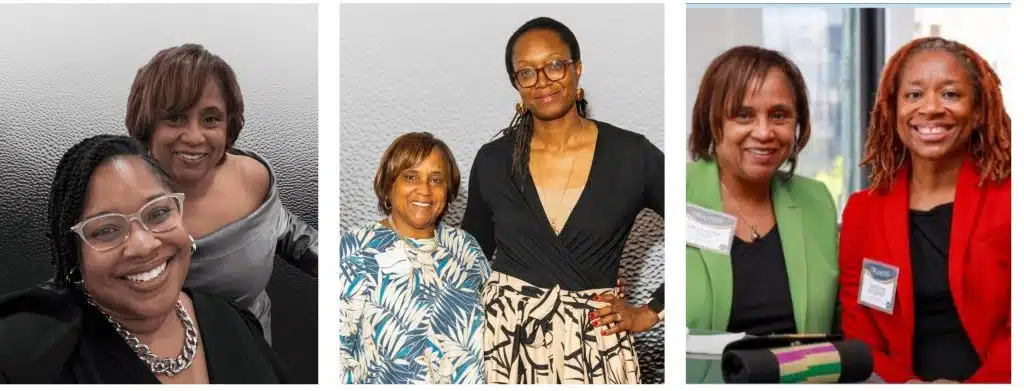
As a charter school CEO and an active member of several local advocacy groups, Dr. Lyles has cultivated mentoring relationships among those who work within or serve the charter sector. This issue’s profile highlights three well-known and highly respected leaders within Philadelphia’s charter school community whose professional paths have been shaped, in part, by their connection to Dr. Lyles.
Dr. Leigh Purnell, CEO of Southwest Leadership Academy Charter School
Dr. Leigh Purnell joined Southwest Leadership Academy Charter School (SLA) in 2017 as its Chief Academic Officer and Principal. She first connected with Dr. Lyles through the African American Charter School Coalition during a particularly turbulent period — the Charter Schools Office was pushing for a nonrenewal of SLA’s operating charter.
“I called Leigh to let her know I was aware of the difficulty she faced and offered to help in any way I could,” Dr. Lyles said.
The two leaders soon discovered they had more than charter schools in common. Dr. Purnell’s godmother, Sydney Easton, is a longtime friend of Dr. Lyles, and both women are members of Alpha Kappa Alpha Sorority, Incorporated. What began as polite greetings at coalition meetings deepened into an intentional mentoring relationship.
“I contacted her when I was working on my superintendent’s program, because you’re required to work with a certified superintendent in the Commonwealth for internship hours to supervise the work that you’re doing,” Dr. Purnell said. “She’s just been such a help and a huge support throughout my time, particularly when I transitioned from being the chief academic officer and principal over to being the CEO.”
As Dr. Purnell describes it, Dr. Lyles’ support was practical, strategic, and candid — extending well beyond the nonrenewal crisis.
“She’s always just a phone call away if something is going on. If I need to bounce something off of her, she’s an excellent thought partner,” Dr. Purnell said. “She’s encouraging, she’s supportive, she’s a great example of high-quality and principled school leadership. She’s also shown me how important it is to mentor others, to be able to pay that forward to any leaders who are coming behind me.”
With an eye toward SLA’s long-term sustainability, Dr. Lyles urged her mentee to rethink her leadership structure. She advised Dr. Purnell to separate the roles of CEO and principal, formalize that change with her board, and identify someone already in the building who could step into the principalship.
“I advised Leigh that she could not continue to do the work of a CEO and principal,” Dr. Lyles said. “I assured her that she would be able to identify someone in her building who could step up to the role of principal. I encouraged her to advocate to her board for these changes. I also provided her with advice on how a charter school CEO should manage her working relationship with the board.”
What began as problem-solving calls has since evolved into a friendship — illustrating, as Dr. Lyles reflected, a vital facet of great mentorship: a mutually rewarding experience.
Dr. Cassandra St. Vil, CEO of Philadelphia Charters for Excellence
When Dr. Cassandra St. Vil stepped into the role of executive director at Philadelphia Charters for Excellence (PCE), she was new to Philadelphia and clear about what she needed: a front-row seat in what she calls the “laboratory” of charter education. As a member of the PCE board, Dr. Lyles served on her interview committee when she was a candidate for executive director and later became a key part of St. Vil’s learning plan — offering perspective both as a school leader and as a governing board member.
Dr. St. Vil chose Keystone Academy as her site for for a school leadership residency while completing a principal certification program at the University of Pennsylvania Graduate School of Education, with whom Keystone has a strong relationship. Keystone’s strong track record in the authorizing process made it an ideal “learning lab” for understanding what effective leadership and charter renewal look like in practice.
“Who leads that? How do you lead that, and how can I learn from you to lead that for the entire city?” she recalls thinking.
Simultaneously, Dr. Lyles continued to mentor her from the board table at PCE, offering a second vantage point on citywide policy and nonprofit leadership.
When Dr. St. Vil needed a formal mentor for the Penn program, she admits there was a brief pause before asking. “There was just a moment of, are you okay being my mentor?” she explains. Dr. Lyles’ response was immediate and unequivocal: absolutely. That quick yes told Dr. St. Vil something essential — that Lyles sees mentorship not as an obligation or a résumé line, but as part of her responsibility to the profession.
“She shows up in the face of everything just calm, settled, steady, and knows exactly what she’s doing and why she’s doing it,” Dr. St. Vil says.
Watching Dr. Lyles lead Keystone and serve on the PCE board taught her how to remain sharp and mission-focused in political and educational circles without being pulled off course by “noise,” influences, or influencers. For a leader who now navigates those same circles daily, that steadying example may be the most enduring lesson of all.
Ms. Widelene Desarmes, Consultant for the African American Charter School Coalition’s 8th Grade Algebra I Program
Ms. Widelene Desarmes entered Dr. Lyles’ orbit through the Algebra I initiative that grew out of work with the African American Charter School Coalition (AACSC). Named as the consultant for the program, Ms. Desarmes helped coordinate advanced Algebra I opportunities for eighth-grade students, with Keystone serving as one of the partnering schools.
Over four years, that partnership required constant coordination: identifying students, arranging testing, organizing bus transportation to the host site, and working through the inevitable logistical challenges. Throughout it all, Ms. Desarmes often remarked that Keystone was the one school she never had to worry about — Dr. Lyles always responded on time and kept communication transparent. To Dr. Lyles, this is not a minor detail; reliability and openness are foundational to what makes mentoring and collaboration possible.
Their relationship has grown well beyond logistics. During the program’s first year, Dr. Lyles visited the summer Algebra I site at Friends Select, where Ms. Desarmes walked her through classrooms and showed the program in action. Since then, their conversations have broadened considerably — especially as Ms. Desarmes juggles pursuing her EdD at Drexel University, being a new mother, and leading a consulting firm. She says she is “taking away so much” from the “gems” Dr. Lyles has shared about work–life balance and leadership, noting that having a mentor means “we cannot do this by ourselves” and that good advice can “make the path easier” by offering a different route or a key connection.
What began as a professional collaboration is gradually becoming something broader: an emerging friendship with clear mentoring overtones, grounded in shared work, mutual respect, and a steady stream of practical wisdom at exactly the moments Ms. Desarmes needs it most.
Why Mentorship Matters
So, why seek a mentor?
According to Dr. Lyles:
“It’s advantageous to get the perspective of people who have done the job. When you have a mentor, you benefit from their experiences. They can tell you how to address a problem in the most efficient way, or steer you to the right resources instead of you spending a great deal of time and effort finding them yourself.”
Mentors save their mentees from “reinventing the wheel,” offering both hard-earned wisdom and encouragement at precisely the moments when it is needed most.
“I have a vested interest in the success of young educators because education is the most important profession and we need qualified people… there were women who invested in me and mentored me. While it wasn’t always formal, professional women supported and worked with me,” Dr. Lyles said.
A Mother’s Influence
When asked about the most influential mentor in her life, Dr. Lyles did not hesitate — she credited her mother.
“My mother was a businesswoman,” she said. “She taught me how to handle personnel issues, manage and administer a staff, make a budget work, and keep the finances of a business intact. I learned that from my mother.”
Those lessons proved critical as Dr. Lyles navigated Keystone through the fiscal and instructional challenges unique to charter school leadership — the same leadership and business acumen that would go on to earn praise from an authorizer often at odds with charter schools.
Planting Seeds
The legacy of mentorship is, to Dr. Lyles, like a tree growing taller with each generation.
“There’s this trickle-down effect… one rolls it down to the other, and so on and so on,” she said.
Her career serves as a living tribute to the idea that investing in others is the surest path to a thriving, sustainable future for education. Whether through formal programs, spontaneous phone calls of support, or daily demonstrations of integrity and professionalism, Dr. Lyles exemplifies the kind of leadership that multiplies. Her story offers lessons for educators as well as anyone seeking to make a lasting impact: mentorship is not a transaction, but the foundation of enduring progress — and quite often, lasting friendships.
“I appreciate having friends and relationships with people who are younger than I am,” Dr. Lyles said. “It keeps me tuned in to current conversations.”