
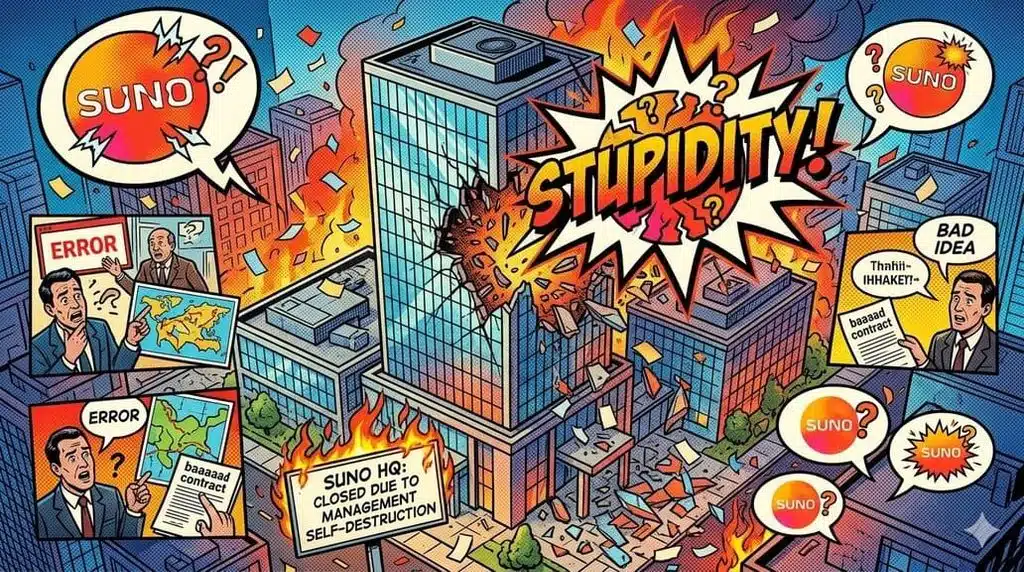
The Suno Controlled-Demolition: Why I’m Canceling My Subscription Today
By Ken Kilpatrick • Communication Analyst, Creator, and Publicist
Let’s stop pretending tech executives have any idea how to run a business once the venture capital checks clear.
Today, September 3, 2026, Suno officially rolled out its updated Terms of Service. If you read their corporate blog post, it’s wrapped in the usual, sickening Silicon Valley vernacular: a “healthy music ecosystem” and a “new approach to downloads.” As a PR executive and creator familiar with contract law and the realities of a production workflow, let me strip away the PR gloss for you.
The Bottom Line First:
Suno didn’t optimize their product today. They executed a masterclass in corporate self-sabotage. They took a category-defining AI asset and transformed it into a digital cage. If you are still holding an active Pro or Premier subscription, you should cancel.
1. The Math of a Walled Garden
Let’s look at the absolute absurdity of the new pricing matrix:
- Pro Tier ($8–$10/mo): 2,500 credits. Generates up to 500 songs. Allowed downloads: 20 tracks per month.
- Premier Tier ($24–$30/mo): 10,000 credits. Generates up to 2,000 songs. Allowed downloads: 60 tracks per month.
If you have ever spent five minutes inside a real production environment, the operational failure here is instantly obvious. Music production is an iterative process. You don’t hit “generate” once and ship a master. You roll variations, isolate instrumentals, and split vocal layers. Suno is perfectly happy to collect premium recurring revenue to let you generate 2,000 song iterations, but they will legally block you from saving more than 60 of them to your local device.
2. The Litigator’s Panic
Suno claims this download restriction is a noble effort to prevent “bad actors” from mass-scraping audio files to flood streaming platforms like Spotify. Let me tell you exactly what this actually is: pure, unadulterated litigation panic.
Suno is currently staring down a massive $400 million copyright infringement lawsuit brought by Sony, Universal, and Warner Music Group. The corporate board is terrified. So, to look like responsible market participants in front of a federal judge, the executives decided to penalize their legitimate, paying subscriber base. Actual so-called “bad actors” and automated scrapers do not care about a UI download limit. Anyone with a basic technical background can route audio through a local hardware loopback in under five minutes.
3. The Model Erasure & Indemnity Shield
Tucked neatly into the announcement is a line that should terrify any creator looking for long-term consistency: “When the new models launch, all prior models will be retired.” Translation: The specific algorithmic engines that built your current music catalog are being wiped off the production servers.
This is standard, aggressive corporate defense strategy. The moment a company plans to fundamentally alter the value proposition of a paid contract, they rewrite the arbitration clause. By adding strict provisions against mass arbitration, they are attempting to **legally immunize themselves from class-action consumer litigation** when subscribers inevitably revolt over broken features and capped data.
The Verdict: Take Your Assets and Walk Away
The generative audio landscape is no longer a corporate monopoly. High-fidelity, open-weight music models are hitting Hugging Face every week, allowing creators to run unlimited generation locally on their own hardware. Stop paying for the privilege of being locked in a cage.
Cancel Your Suno Subscription Now