
You Don’t Have to Live with That Bad Review
How Schools Can Fight Back Against Unfair Online Ratings
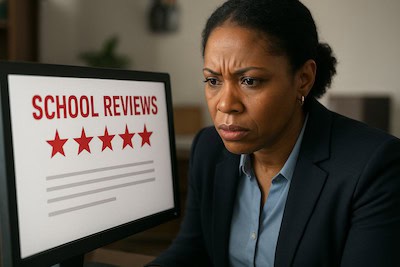
Every school leader knows the sinking feeling. You open a review platform, and there it is — a scathing one-star review filled with half-truths, outdated grievances, or outright fabrications. It feels permanent. It feels damaging. And worst of all, it feels like there’s nothing you can do about it.
You are not Powerless
Most review platforms, including major contenders like Niche.com and SchoolDigger, have detailed content policies that protect schools from reviews rooted in misinformation, misunderstanding, and misrepresented facts. The problem is that most schools don’t know these policies exist, or how to leverage them effectively.
That’s not to say the process is easy. Companies investigate review complaints with skepticism. If they did not do so, many of those who earned their negative reviews would take advantage of a lenient policy to remove unfavorable material.
The Myth of the Untouchable Review
There’s a common misconception that once a review is posted, it’s set in stone. Administrators often assume that freedom of speech means freedom from accountability and that platforms will always side with the reviewer.
That simply isn’t true. Review platforms have a vested interest in maintaining their credibility, so they actively remove content that breaches their guidelines. Consider this—a school review site that ignores negative reviews from former employees pretending to be unhappy parents would quickly lose trust. No school would subscribe to their “premium plans,” and real estate sites wouldn’t link to them.
The key is understanding what qualifies for removal and how to present your case. That’s not easy, and the burden is on the complainant. But if your school has been wronged, you have a case and should take action.
When Reviews Cross the Line
Not every negative review is removable, nor should it be. Honest, experience-based input helps schools grow. But a surprising number of damaging reviews fall outside the boundaries of what platforms permit.
Let’s look at some of the most common scenarios we’ve seen where schools have legitimate grounds to push back.
Reviews that aren’t based on real experience. Platforms require that reviews reflect genuine, firsthand knowledge. If a reviewer has no actual affiliation with your school — maybe they’re a disgruntled community member who never enrolled a child, or someone confusing your institution with another — that review doesn’t belong on your page. The same applies to content generated by AI tools and chatbots, which platforms are increasingly cracking down on as automated review manipulation becomes more common.
Reviews that contain verifiably false information. This scenario often occurs when parents or caregivers lack the courage to address grievances with school administrators but feel empowered to lodge complaints behind the safety of a computer screen. Coincidentally, our experience shows that nearly 90 percent of these cases stem from a parent’s misunderstanding of a school policy or of how a situation played out.
References that are demonstrably untrue have high potential for removal. The standard here is that the inaccuracy must be clear and indisputable. However, you’d be surprised how often reviewers get basic details wrong—especially when they’re writing from emotion rather than experience. And so, if a negative review is partially true, but contains errors, the entire entry must be removed—even if a “bad situation” occurred. School review sites do not edit reviews: either a challenged review stands or its completely removed.
Reviews that target individuals. This is one of the most common violations schools encounter. A frustrated parent names a teacher, a student calls out an administrator, or someone provides enough situational details to identify a staff member. Most platforms explicitly prohibit this kind of content, and it’s one of the easier categories to get removed. Unfortunately, it’s one of the easiest to slip through, so schools need to be vigilant in guarding their review accounts.
Reviews driven by outside influence. When there’s evidence that a reviewer was coached, coerced, or part of a coordinated campaign — say, a group of parents organized to flood a page with negative ratings after a policy dispute — platforms take that seriously. Manipulated star ratings and influenced content undermine the integrity of the entire review ecosystem. Charter schools are at high risk for this scenario. When special interest groups target a charter school for nonrenewal or to support a revocation action, attacking the school’s online profile with low-star ratings and negative reviews is a common tactic.
The Gray Areas Work in Your Favor Too
Even reviews that contain a kernel of truth can be removed if they include technical violations. A parent might have a legitimate grievance about a classroom experience, but if that review makes a staff member identifiable, contains a link to an external website, advertising content, copyrighted material, or language that can be interpreted as inappropriate, those elements can be grounds for removal.
Reviews that mention specific criminal allegations are another often overlooked category. Platforms are not law enforcement agencies, and reviews that accuse individuals or organizations of particular crimes usually violate content policies — even if the reviewer believes their claims are justified. General comments about school-wide issues are generally allowed, but direct accusations are a completely different matter.
Even nonsensical content — reviews that read more like personal rants, contain song lyrics, or are simply unintelligible — can be flagged and removed.
Why Most Schools Fail at Getting Reviews Removed
If removal is possible, why do so many schools struggle with it? The answer is usually one of three things:
- They don’t know the policies well enough to identify violations
- They don’t present their case effectively to the platform
- They give up after an initial denial.
The third bullet is crucial. Review removal requests require a strategic, well-documented approach: identifying the specific policy violations, documenting the evidence, and communicating with the platform in the language they respond to. School review websites are horrendous for slow responses for schools that do not have paid memberships. If you’re going to initiate a case for review removal, you need to make the time for aggressive and sustained follow-ups—and by the way, each of those follow-ups needs to be well-documented.
Proactive Review Management
The best defense against unfair reviews isn’t just knowing how to remove them. Rather, it’s making sure they’re vastly outnumbered by authentic, compelling voices that tell the real story of your school. That doesn’t happen by accident. It takes a deliberate, repeatable strategy built into the rhythm of every school year.
Launch a review campaign at the start of each school year. Timing matters. Early in the year, families are energized, optimistic, and still reflecting on the positive decision they made to enroll or re-enroll their children. This is the ideal window to begin capturing their perspectives. Make it an annual initiative that is as routine as back-to-school night or picture day. Assign ownership to your communications staff or contracted PR agency so it doesn’t fall through the cracks.
Conduct real interviews. Don’t just blast an email with school review websites asking for participation. Doing so is a fast track to a failed campaign. It simply doesn’t work.
The keyword here is “campaign.” Schools should not seek reviews as a standalone effort. Rather, reviews should be a part of an overall reputation management campaign that seeks to share stakeholder stories.
When schools blast out an email asking parents to leave a review, the most they get back, if anything, is a handful of well-meaning but ultimately forgettable comments. “Great school!” and “The teachers are nice!” might feel good to read, but they carry almost zero weight with prospective families researching where to send their children. These kinds of surface-level reviews don’t recruit staff and students who are best aligned with your school’s mission.
What works best is specificity. A parent describes how the school’s STEM program sparked her child’s interest in engineering. A family explaining how the school’s approach to social-emotional learning helped their child come out of her shell. An alumnus crediting a particular program with preparing him for college in ways his peers from other schools weren’t. These are the testimonials that resonate — and they rarely come from a blank text box and a “please leave us a review” email.
Do the Work for the Stakeholder
This is why the interview process is so important. A skilled communications professional or PR expert knows how to steer a conversation, helping parents naturally express the specific benefits they’ve experienced. These experts ask appropriate follow-up questions and draw out details about the curriculum, programs, the school’s mission, and the daily culture that make a testimonial truly convincing. Often, interviewees don’t realize how valuable their insights are until someone with the right expertise helps them find the right words.
Turn those interviews into multi-purpose assets. This is where the “campaign” comes. The content you gather through these conversations is far more valuable than a single online review. You need to solicit interviews for the purpose of sharing family success stories.
Well-crafted testimonials pulled from parent and alumni interviews become powerful material for enrollment marketing brochures, grant applications, fundraising campaigns, and donor communications. And for charter schools, parent stories from interviews are a powerful addition to your operating charter renewal application. One thirty-minute interview can yield quotes and narratives that serve your school across a dozen different channels for an entire year.
Turn the best quotes into online reviews. Once your communications or PR staff has conducted the interviews and identified the most compelling, detailed responses, the next step is crucial, but simple. Go back to those specific interviewees, let them know how insightful and helpful their perspective was, and ask if they’d be willing to post a portion of their comments that you identified as powerful on school review platforms. Most people are happy to help — especially when they’ve already done the hard part of participating in the interview.
The key is making it effortless for the interviewee. A savvy communication specialist or PR professional will craft interview questions that solicit responses the school can use to promote specific successes. Pull the appropriate excerpt from the interview, polish it lightly if needed, and email it to the parent with a link to the review site. All the parent has to do is copy, paste, and submit.
You’re not putting words in anyone’s mouth — you’re simply making it easy for people who already said something wonderful to share it where it counts. The review is still entirely their words, rooted in their genuine experience, and that authenticity comes through.
The compounding effect is powerful. Over time, this annual practice builds a deep, rich library of detailed reviews that paint an accurate and compelling portrait of your school. When the occasional unfair or inaccurate review appears (and it will), it lands in a sea of specific, credible, firsthand accounts that immediately put it in context. Prospective families scrolling through your reviews won’t fixate on one bitter outlier when they’re surrounded by parents speaking passionately about real programs, real growth, and real results.
Whether you need to Eliminate or Generate Reviews, You Don’t Have to Do This Alone
Whether you’re defending your school against bad reviews or launching a campaign to generate positive stories, the process is cumbersome and time-consuming. Be sure to engage staff who can undertake the process without losing sight of their “day job.”
Sylvia Marketing & PR has helped clients successfully get false, inaccurate, and slanderous content removed from major platforms. Moreover, we have helped schools generate positive results through coordinated campaigns. We understand the nuances of content policies inside and out and know how to build a compelling case for removal, even in situations that seem hopeless at first glance. Whether the review is entirely fabricated or contains a legitimate complaint wrapped in technical policy violations, the right representation can make all the difference.
If your school is struggling under the weight of unfair online reviews, you likely have more options than you think.
Conversely, if you’d like to initiate a campaign to generate stakeholder success stories and harvest testimonials for school review websites, but don’t have the time or personnel to do so, contact Sylvia Marketing at 215-817-3095 or results@sylviamarketing.com.