
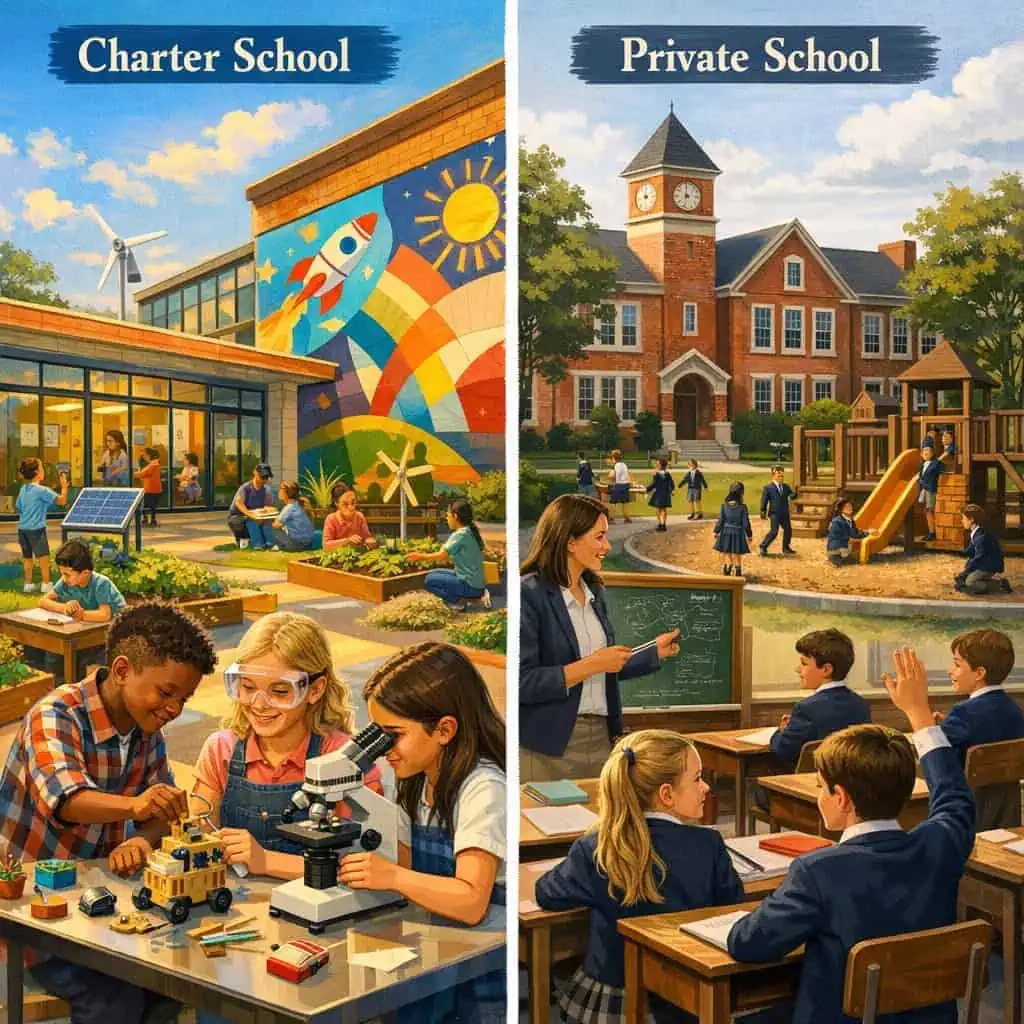
Charter Schools and Private Schools: Understanding the Key Differences for American Families
Choosing the right school for a child is one of the most significant decisions parents face. Private and public charter schools offer educational experiences as alternatives to traditional neighborhood schools. They differ fundamentally in terms of funding, governance, admissions, and accountability.
Funding and Tuition-Free Key Differences
The most fundamental distinction between charter and private schools lies in how they are funded and whether families pay tuition. Charter schools are publicly funded institutions. They receive taxpayer dollars, typically allocated on a per-pupil basis from state and local governments. Because of this public funding model, charters are tuition-free for all students. Families do not pay enrollment fees or annual tuition costs, making them accessible regardless of a family’s financial circumstances.
Private schools, by contrast, rely primarily on tuition payments from families, along with private donations, endowments, and fundraising efforts. Tuition can range from a few thousand dollars to more than 50,000 USD. While many private schools offer financial aid and scholarship programs, the tuition-based model inherently creates financial barriers that may limit access for lower-income families.
This distinction has significant implications for educational equity. Charter schools, as tuition-free options, theoretically provide families across all income levels with educational opportunities. Private academies are often out of reach for families that do not have substantial financial resources.
Governance and Operational Autonomy from the Local Public School District
Both charter and private schools operate with greater independence than traditional public schools, but the nature and source of that autonomy differ considerably. Charters derive their autonomy from formal agreements—known as operating charters—with state or local authorizing bodies. These agreements grant them flexibility in curriculum design, staffing decisions, budget allocation, and instructional methods. In exchange for this operational freedom, charter schools agree to meet specific performance benchmarks and accountability standards outlined in their charter. This model allows charters to innovate and experiment with educational approaches while remaining part of the public education system.
Private academies possess inherent autonomy stemming from their independent status rather than from contractual agreements with government entities. Private school governance typically involves a board of trustees or directors, religious organizations, or independent ownership structures. These governing bodies have wide latitude to establish the school’s mission, curriculum, hiring practices, and operational policies without seeking approval from state education authorities. This independence allows them to maintain specific religious affiliations, educational philosophies, or cultural traditions that are not permissible in publicly funded institutions.
Specialization and Educational Focus in K-12 Education
Both charter and private models offer specialized educational programs that set them apart from traditional public schools. Charters often address particular educational niches with focused missions such as STEM education, performing arts, language immersion, project-based learning, or serving specific student populations. This specialization is central to their founding charters and identities.
Private schools similarly offer specialized programs, including religious education, classical curricula, Montessori or Waldorf methodologies, college-preparatory programs, or arts-focused instruction. The specialization in private schools often reflects the institution’s founding philosophy or the preferences of its governing body and community.
For parents considering either option, a thorough investigation is essential. Not all charter or private schools deliver on their specialized promises equally. Families should examine curriculum details, teacher qualifications, student outcomes, and school culture to determine whether a school’s stated focus translates into meaningful educational experiences.
Good Schools Tend to Mount Waitlists: Lotteries vs. Selective Enrollment
How students gain admission and who ends up on enrollment waitlists represents another significant difference between these school types. Charter schools, as public institutions, cannot selectively admit students based on academic ability, behavior records, or other screening criteria. When a charter school has more applicants than available seats—a common occurrence at popular schools—federal and state laws typically require a lottery to determine enrollment. This randomized selection process ensures that admission is not based on subjective evaluations or a family’s ability to navigate complex application processes. Some charter schools may give preference in lotteries to siblings of current students or children residing in specific geographic areas, but the fundamental principle of non-selective admission remains.
Private schools generally employ selective admissions processes. These may include entrance examinations, academic transcript reviews, interviews with students and families, teacher recommendations, and essays. Private schools can establish their own admissions criteria and select students who they believe will thrive within the school’s particular environment or who meet specific academic, behavioral, or mission-related standards. This selectivity allows private schools to curate their student bodies but also raises questions about accessibility and diversity.
Additionally, charter lotteries, sibling and priority rules, and district residency requirements can shape waitlists for charter schools, while private schools’ waitlists can be influenced by available scholarships, religious affiliation, fundraising commitments, and institutional priorities, all of which contribute to key distinctions in who gets in, who must wait, and how families navigate choices when comparing the difference between charter schools and private schools.
Accountability Mechanisms of Charter Schools and Private Schools
Who holds these schools accountable—and for what—differs substantially between the two models. Charter schools operate under a dual accountability framework. They must satisfy the terms of their charter agreement, which typically includes meeting academic performance targets, maintaining financial transparency, and fulfilling their stated mission. Authorizing bodies—which may be state education agencies, local school districts, or independent charter boards—have the power to renew, revoke, or place conditions on a charter based on school performance. Additionally, because charter schools are publicly funded, they are subject to various state regulations regarding student assessment, reporting requirements, and civil rights protections.
Private school accountability operates through market mechanisms and internal governance. The primary accountability relationship exists between the school and tuition-paying families—if parents are dissatisfied with the education their children receive, they can withdraw their children from the school and take their tuition dollars elsewhere. Private school governing boards also provide oversight, establish policies, and evaluate school leadership. While private schools must meet basic state requirements for health, safety, and compulsory education laws, they generally face fewer regulatory mandates regarding curriculum, testing, and reporting than their publicly funded counterparts.
Implications for Families
Understanding these structural differences helps families make informed decisions aligned with their values, circumstances, and children’s needs.
Families seeking expanded educational options without financial barriers may find charter schools particularly appealing. The tuition-free model, combined with specialized programming and operational flexibility, provides alternatives that might otherwise be inaccessible.
Families prioritizing specific religious instruction, highly selective academic environments, or particular educational philosophies may gravitate toward private schools, provided they have the financial means or access to financial aid.
Regardless of which path families consider, active engagement in the evaluation process is critical. Visiting schools, speaking with current families, reviewing performance data, and understanding the school’s culture and expectations will yield better outcomes than assumptions based on school type alone.
Difference Between Charter Schools & Private Schools: Comprehensive Comparison Chart
| Category | Charter Schools | Private Schools |
| Funding Source | Publicly funded through state and local tax dollars | Privately funded through tuition, donations, and endowments |
| Tuition Cost | Tuition-free for all enrolled students | Tuition required; costs vary widely (often thousands to tens of thousands of USD annually) |
| Financial Accessibility | Open to families of all income levels | May be limited by family’s ability to pay tuition; financial aid may be available |
| Source of Autonomy | Derived from charter agreement with authorizing body | Inherent independence from government oversight |
| Governance Structure | Governed by charter board; operates under terms of charter contract | Governed by board of trustees, religious organization, or private ownership |
| Regulatory Oversight | Subject to state education regulations and charter agreement requirements | Minimal state regulation; must meet basic health, safety, and compulsory education laws |
| Admissions Process | Non-selective; lottery-based when oversubscribed | Selective; may include entrance exams, interviews, and application reviews |
| Admissions Criteria | Cannot screen students by academic ability or behavior | Can establish specific admissions standards and select students accordingly |
| Specialization Options | Often founded with specific missions (STEM, arts, immersion, etc.) | Frequently offer specialized programs (religious, classical, Montessori, college prep, etc.) |
| Primary Accountability | Authorizing body (state agency, district, or charter board) based on charter agreement | Tuition-paying families and governing board |
| Performance Consequences | Charter can be revoked or not renewed for poor performance | Enrollment decline if families are dissatisfied; board may intervene |
| Religious Affiliation | Prohibited from religious instruction (public institution) | May be religiously affiliated and provide religious education |
| Teacher Certification | Requirements vary by state; some flexibility allowed | Generally not required to employ state-certified school teachers |
| Student Demographics | Required to serve all students, including those with disabilities and English learners | May have more homogeneous student populations based on selective admissions |
Key Takeaways of Charter Schools vs Private Schools
- Funding is the key difference: Charter schools are tuition-free public schools, while private schools require tuition.
- Autonomy comes from different sources: Charters operate under government-approved agreements; private schools have inherent independence.
- Admissions reflect public vs. private status: Lotteries ensure equitable access at charters; selective processes allow private schools to curate enrollment.
- Accountability mechanisms differ: Charters answer to authorizers and state regulations; private schools answer primarily to paying families and internal boards.
- Both offer specialization, but parents must investigate whether schools deliver on their promises. Understanding these distinctions empowers families to navigate school choice with clarity, ensuring the educational environment they choose aligns with their child’s needs and their family’s values.
Private and charter school options are at the forefront of America’s school choice movement. While charter school students receive free education, private schools are often expensive, with tuition sometimes in the tens of thousands of dollars. The gap is wide, and questions of equity forge many debates. Private school students tend to come from wealthier families and face few, if any, limitations on school choice, whereas many inner-city children languish on charter school enrollment waitlists, unable to escape failing, overcrowded, and dangerous neighborhood schools within school districts that either cannot or will not meet their needs. We will address that disparity in an upcoming blog. Keep checking back.