
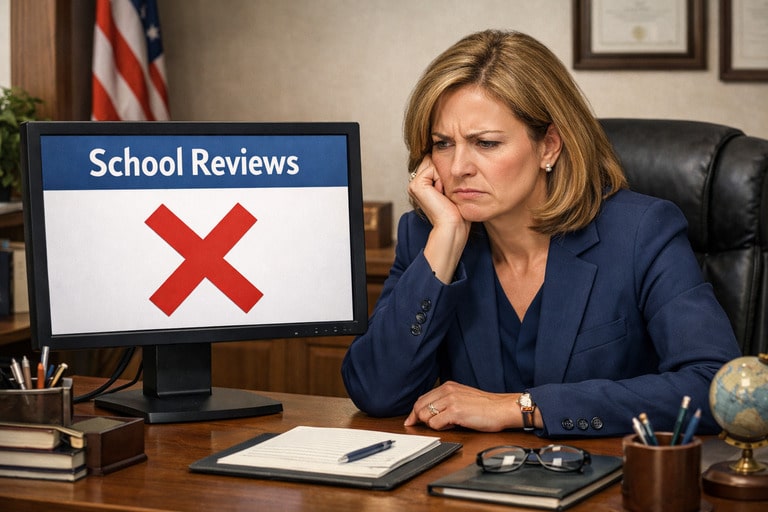
Bad Review, Wrong Facts: How K-12 Schools Can Push Back the Right Way
A harsh review can sting. A false review can do real damage. School leaders do not have to accept made-up claims, speculation, or invented stories as part of doing business online. When a review crosses from opinion into false statement, platforms often give schools a path to challenge it through internal reporting tools and manual review channels.
False statements, speculation dressed up as fact, posts from people with no real connection to the school, and content that exposes private information.
Plain opinion, disappointment, and criticism based on a real experience, even when the school believes the review is unfair or one-sided.
Calm reporting, exact policy language, and proof that points to a clear rule violation instead of a broad complaint about tone.
When a negative review is removable
Due to our work in school public relations, Sylvia Marketing & Public Relations is often asked to help get negative reviews removed. But the reality is is, most platforms will not remove a review simply because it is harsh. A school usually gets traction only when a review breaks a platform rule. In practice, that means the review must contain something more than criticism. It must include a false factual statement, a speculative claim written as if it were proven, a post from a person with no real experience with the school, or content that reveals private information about a student, parent, teacher, or staff member.
A useful test is simple. Ask whether the statement can be checked. “I did not like the principal’s manner” is opinion. “The school has no anti-bullying policy” is a factual statement that can be tested against published policy. “I heard the school hides incidents” is speculation, not firsthand experience. That difference matters because moderation teams are trained to leave opinion alone and act on policy violations.
Three review types that deserve close attention
- Speculative claims: accusations built on rumor, assumption, or guesswork rather than direct experience.
- Opinion stated as fact: a personal conclusion rewritten as an objective claim, such as saying a school is unsafe without any concrete event or support.
- Factually false statements: claims about programs, staff, safety, enrollment, academics, or discipline that public records or school records can disprove.
Build the case before you click report
Schools lose time when a staff member reports a bad review in a rush. A better approach is to pause, isolate the exact sentence that breaks policy, and gather proof before submitting anything. A moderator should be able to read the report and see the violation in under a minute.
Start by copying the full review into an internal document. Highlight each statement that can be tested. Next to each line, note whether the issue is false fact, speculation, no genuine experience, harassment, or privacy. Then attach proof. That proof may include a link to the school handbook, a public page listing programs, state report-card data, a screenshot of the reviewer profile, or an internal confirmation that no student or parent matching the story can be found in school records. Keep private student information out of the report. State the result of the record check without exposing protected details.
If a review says a school has no honors program, include the direct page that lists the honors program. If a review says a student complaint was ignored and the named person never attended the school, say the school has no record matching the account described. The stronger the proof, the easier the decision for the moderator.
How to request manual review the right way
1. Match the review to the closest policy category
Do not choose a reporting option at random. Select the category that fits the violation most closely, such as misinformation, fake content, harassment, or personal information. Then write one short paragraph explaining why that category applies. Use the platform’s own language where possible.
2. Ask for a human review with one clear factual point
When a text box is available, give the moderator one strong reason to act. Example: “This review contains a false factual statement. It says our school offers no after-school programs. Our official activities page lists twelve active programs. Please send this for manual review as misleading content.” A short, direct note is more effective than a long emotional message.
3. Re-submit after denial with sharper evidence
If the first report fails, do not send the same note again. Tighten the claim. Quote the exact sentence that is false. Add a cleaner link. Attach a screenshot that shows the problem more clearly. A second request should look more precise, not more upset.
4. Use the no-genuine-experience angle when the reviewer appears unrelated
If the school cannot match the reviewer to a parent, student, or visitor account described in the post, say so carefully. The point is not to prove identity. The point is to show the platform that the review may not reflect a real experience with the school and should be checked by a human moderator.
Language that helps and language that hurts
The strongest reports are disciplined. The weakest reports sound angry, wounded, or vague. A moderator is not deciding who seems nicer. A moderator is looking for a rule violation. That means the school should write with restraint.
Better: “This review contains a false statement of fact. It claims the school has no arts instruction. Our curriculum guide confirms weekly visual arts and band instruction for grades 4 through 8. Please review this as misleading content.”
Worse: “This review is outrageous and unfair. We work hard and do not deserve this attack. Please remove it right away.”
The first report gives a moderator something to verify. The second gives only emotion. One can be acted on. The other usually cannot.
What to do when removal is not available
Some reviews will stay up because the writer is sharing a real opinion based on a real experience. When that happens, the goal changes. Instead of chasing removal, post a short public response that is calm, civil, and free of student details. Correct the narrow factual point if one exists, invite an offline conversation, and stop there. Do not argue in public. Do not reveal records. Do not let one review pull the school into a running dispute.
Over time, the schools that handle this best are the ones with a repeatable process: monitor reviews, screen for removable content, gather proof fast, submit a tight report, and answer non-removable criticism with restraint. That approach protects reputation without wasting money or staff time.
Proactive, Specific Reviews Are Your School’s Best Defense
A school’s most effective defense is encouraging families to submit detailed, incident-specific reviews each academic year. The more reviews that highlight how challenges were addressed, fears alleviated, or daily life was improved, the more impactful they become. It is essential that reviewers specify the programs, staff members (preferably by title), and processes that contributed to their children’s success despite obstacles.
Vague testimonials such as “the school is the best” or “the teachers are caring” lack the substance necessary to attract prospective students, prospective staff, and philanthropic support. To enhance the quality and effectiveness of these reviews, Sylvia Marketing & Public Relations offers school clients tailored explainer videos, infographics, and memes. These tools assist stakeholders in articulating their experiences compellingly, thereby strengthening the school’s reputation and appeal.
By taking this extra step, your school can build a robust collection of positive reviews that not only attract new families and staff but also help mitigate the impact of any negative feedback.