
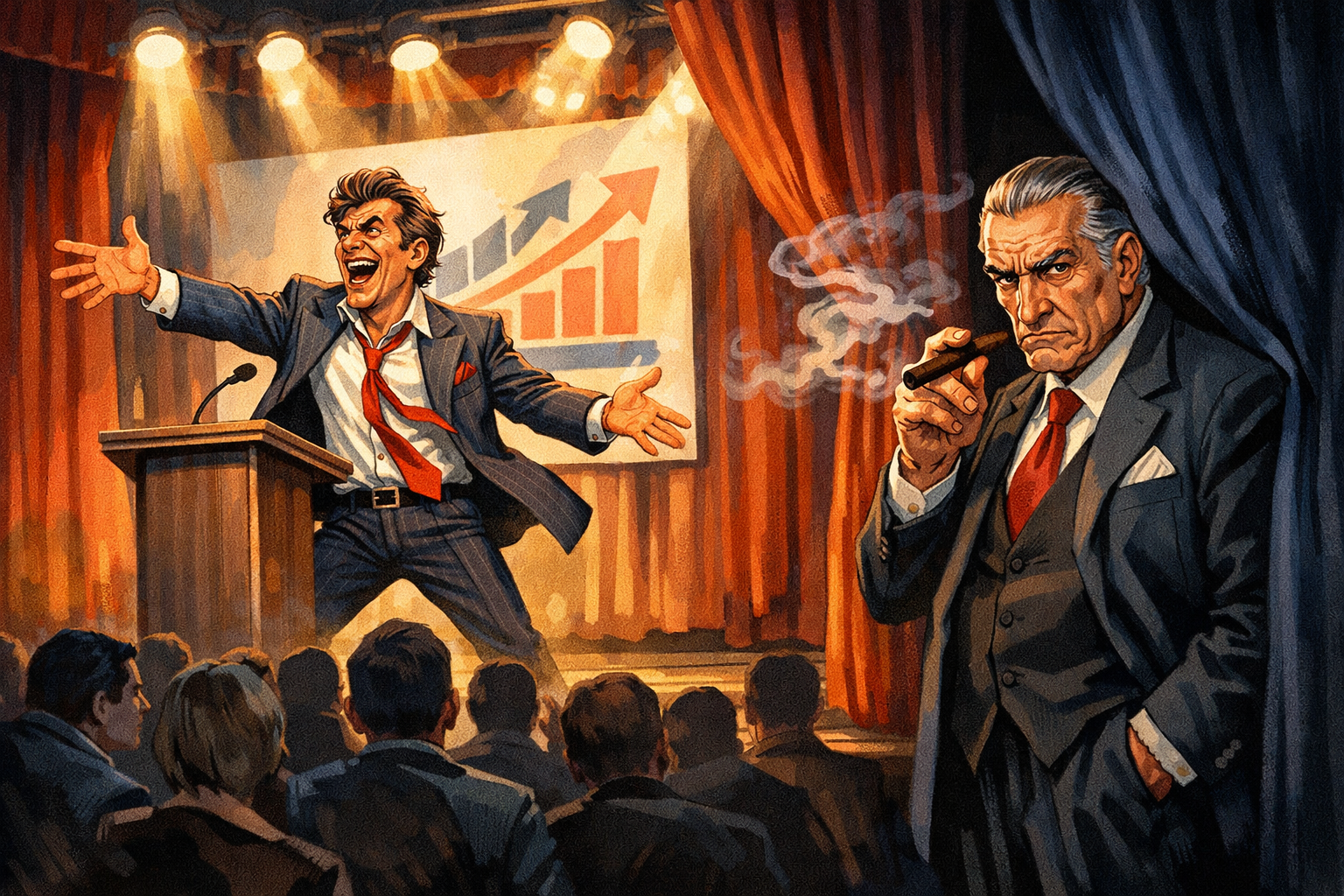
A Don Doesn’t Remove His Jacket!
There is a moment in every revolution where the idealists lose control of the monsters they create.
When Tom Peters tore off his suit jacket on stage in the mid-1980s, he thought he was liberating the American worker. He believed he was injecting raw, human energy into a stagnant corporate machine. But standing in the wings, watching through a cloud of cigar smoke, Lee Iacocca saw the truth.
“Tommy,” the Chrysler chief grunted, “a Don doesn’t remove his jacket.”
It wasn’t a lecture on style. It was a warning about gravity.
Peters wanted “Extreme Humanism.” He wanted companies to listen to frontline workers and build cultures around “raving fans.” He believed that by shedding the stiff, armor-like uniform of the old guard, managers would finally look their employees in the eye.
Instead, he pulled the first thread on a sweater that would entirely unravel.
The Shift from “Us” to “Me”
The corporate uniform did not exist to make people uncomfortable; it existed to enforce a standard of self-effacement. When you put on the suit, your personal quirks, your moods, and your ego were suppressed in service of something larger: the customer, the product, the company. The dress code was a daily physical reminder that you were there to serve.
Once the jacket came off, the boundaries blurred. If the boss could dress for comfort, why couldn’t everyone else?
The transition from khakis to hoodies seemed harmless, but it perfectly tracked a deeper psychological shift in the workforce. Over the decades, the focus subtly drifted away from the customer and landed squarely on the worker. The standard of excellence was replaced by a standard of personal preference.
Today, this evolution has reached its logical conclusion. Every summer, a fresh wave of twenty-two-year-olds enters the office environment straight from the university classroom. They possess no corporate track record, zero years of experience, and no understanding of what it takes to build a sustainable business. Yet, their first demands are almost entirely internal. They expect the workplace to adapt to their emotional needs, cater to their comfort, and provide immediate validation.
The primary question in the modern office is no longer, “How do we serve the customer better today?”
It has become, “How does this environment make me feel?”
The Death of Service First
This is the irony Peters never saw coming. By championing the individual, he accidentally weaponized the ego.
The “service first” attitude requires a certain amount of humility. To create a raving fan, you occasionally have to swallow your pride, put your own discomfort aside, and perform a role. The uniform was the costume that allowed workers to play that part flawlessly.
Without the uniform, there is no separation between the self and the job. If customers criticize the service, they are no longer criticizing a representative of the company. They are attacking the worker’s personal identity. Because the modern environment treats the employee’s comfort as the ultimate priority, the very concept of subservience to the customer feels offensive to the new generation.
As the dress code waned, so did the stamina for hard work. The rigorous standards that Peters and his contemporaries held dear—the relentless pursuit of quality, the obsession with detail, the pride in execution—were slowly traded away for a softer, more accommodating workspace.
The Cost of Comfort
Walk into any modern corporate office today. The heavy oak desks are gone. The ties are entirely extinct. Workers sit in ergonomic beanbag chairs, wearing soft athleisure, sipping complimentary cold brew, and discussing their boundaries. Nobody is shouting. Nobody is sweating through their shirt like Tom Peters did.
Everyone is perfectly, undeniably comfortable.
We got exactly what we asked for. The rigid hierarchy is dead. The demanding bosses of the 1980s have been replaced by empathetic managers who tread lightly around their staff. The friction of the old corporate world has been completely smoothed over.
And yet, look closely at the actual output. Look at the declining quality of customer service across every major industry. Watch a new hire walk out of a meeting because the feedback felt too sharp. Notice how difficult it has become to find anyone willing to take absolute accountability when something goes wrong.
The jacket stays on the back of the chair now. The office is soft, quiet, and entirely focused on the well-being of the people inside it.
Iacocca sat in the dark, watching the beginning of the end, knowing exactly what happens to an army when it stops wearing the uniform.